 Artificial Intelligence
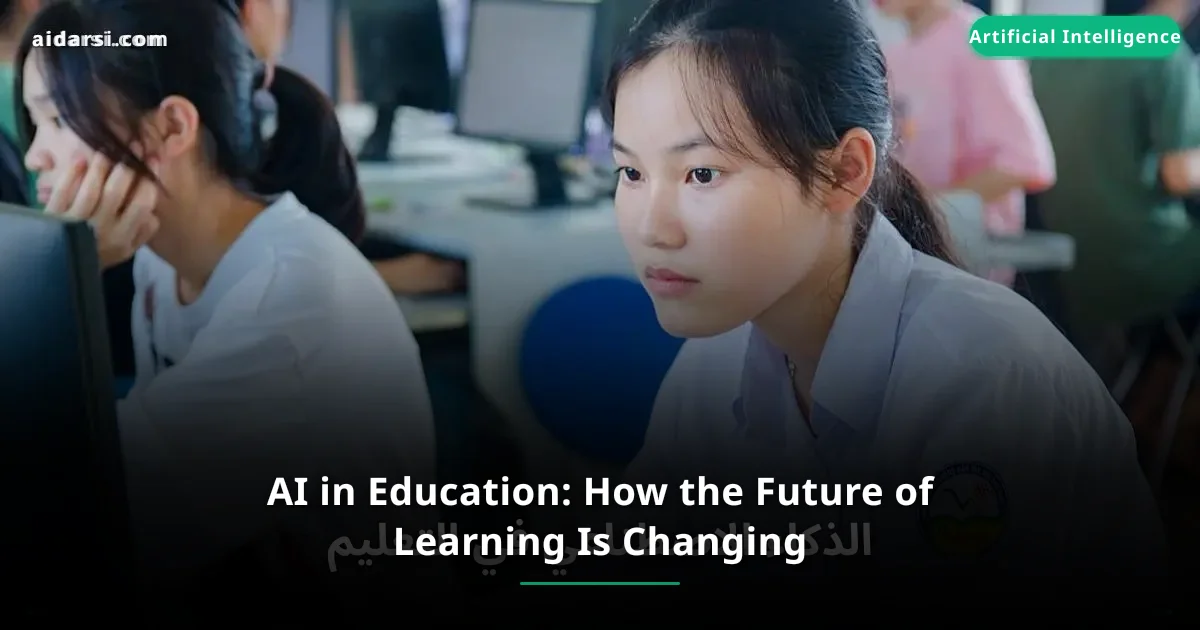
AI in Education: How the Future of Learning Is Changing
Discover how AI is transforming education from personalized learning to smart assessment. Free tools and practical examples for using AI in studying and teaching.
What you will learn
- You will understand how AI is revolutionizing the way we learn and teach
- You will discover free AI tools that can help with your studies today
- You will learn about the real challenges of using AI in education and how to handle them
Imagine sitting in front of a private tutor who knows your weak points exactly, explains things the way you understand -- not one way for everyone -- and is available 24 hours a day. This isn't a distant dream. This is what AI is doing in education right now.
The real question isn't "will education change?" -- it's "are you ready for this change?"
What Does AI in Education Mean?
AI in Education means using machine learning algorithms and natural language processing to personalize the learning experience, automate assessment, and analyze student performance in real time. Simply put: transforming education from "one size fits all" to "an experience designed for you."
The concept isn't entirely new. What changed is the capability. Models like GPT-4, Gemini, and Claude now understand context, explain complex concepts, and even generate precise exam questions -- in multiple languages.
According to UNESCO's 2025 report, over 60 countries have incorporated AI into their national education strategies -- compared to just 15 countries in 2021.
If you're new to AI, start by reading AI Basics to understand key terminology before continuing.
How Is AI Changing the Way We Learn?
Change is happening on several levels -- some visible now, some will surprise you within a few years. Here are the main areas:
Personalized Learning
Remember that moment when the teacher explained a lesson too quickly and you didn't understand -- but were too embarrassed to ask in front of everyone? AI solves this problem at its root.
Platforms like Khanmigo (from Khan Academy) track your level in every subject with precision. If you struggle with fractions, it doesn't automatically move to the next lesson. Instead, it presents additional exercises designed for your specific weak point -- with a different explanation style than the first time.
According to a Stanford HAI study, students who used AI-powered personalized learning systems improved their scores by 30% compared to traditional methods.
AI Tutor
Instead of searching for hours, you can ask a smart tutor that understands your study context. Not just a dry answer -- but a detailed explanation suited to your level.
But note a crucial point: the AI tutor isn't here to do your homework for you. The goal is to understand the concept deeply, not copy a ready answer. If you want to learn how to communicate with these tools effectively, check out our Prompt Engineering Guide.
Use ChatGPT or Claude as a private tutor smartly: ask it to explain a concept "as if I'm in 10th grade" or "give me a real-life example." The more specific your request, the clearer and more useful the explanation.
Smart Assessment (AI-Powered Assessment)
Grading 200 exam papers takes a teacher days. AI does it in minutes -- not just multiple choice, but even essay answers that require contextual understanding.
Systems like Gradescope analyze student responses, detect recurring error patterns, and suggest where the class needs extra review. The result? Teachers reclaim 13 hours per week that were lost to grading -- according to McKinsey -- and invest that time in direct student interaction.
Automatic Content Creation
Need to explain algorithms in a simplified way? Want 20 practice questions on quadratic equations at different difficulty levels? AI generates this content in seconds -- with model answers and logical progression.
Smart teachers use these tools to free up their time. Hours that were consumed by preparing worksheets now become hours spent on what AI can't do: inspiring students and answering their deep questions.
AI Education Tools You Can Try Now
You don't have to wait for your school to adopt these technologies. Here are the top available tools:
| Tool | Use | Price | Arabic Support |
|---|---|---|---|
| Khanmigo | Personal tutor + interactive exercises | Partially free | No |
| Duolingo Max | AI-powered language learning | Partially free | Yes |
| ChatGPT | Concept explanation + practice questions | Free | Yes |
| Claude | Text analysis + academic writing | Free | Yes |
| Quizlet AI | Smart review flashcards | Partially free | Limited |
| Socratic | Problem solving by photo | Free | No |
Want to explore more tools across different areas? Check Best AI Tools in 2026.
Don't rely on just one tool. Each excels in a specific area: ChatGPT for general explanations, Claude for deep academic analysis, Quizlet for quick pre-exam review. Combine them based on your needs.
Practical Example: Smart Review System in Python
Here's a simplified model of a program that selects review questions based on your weak points -- the same principle used by major platforms:
# Smart review system — focuses on weak points
import random

# Question database by subject and difficulty
questions = {
    "Mathematics": [
        {"q": "What is 15 x 12?", "a": "180", "difficulty": 1},
        {"q": "Solve: 2x + 5 = 15", "a": "x = 5", "difficulty": 2},
        {"q": "What is the derivative of x^3 + 2x?", "a": "3x^2 + 2", "difficulty": 3},
    ],
    "Programming": [
        {"q": "What's the difference between list and tuple?", "a": "list is mutable, tuple is immutable", "difficulty": 1},
        {"q": "What is recursion?", "a": "A function that calls itself", "difficulty": 2},
    ]
}

# Student performance per subject (0 to 1)
performance = {"Mathematics": 0.4, "Programming": 0.8}

def get_next_question(perf):
    """Select the next question based on weak points"""
    # Find the weakest subject
    weakest = min(perf, key=perf.get)

    # Choose appropriate difficulty for the level
    target_diff = 1 if perf[weakest] < 0.5 else 2
    pool = questions[weakest]
    suitable = [q for q in pool if q["difficulty"] <= target_diff]

    return weakest, random.choice(suitable or pool)

# --- Run ---
subject, next_q = get_next_question(performance)
print(f"Weakest subject: {subject}")
print(f"Question: {next_q['q']}")
This is a simplified educational model. Real systems like Khanmigo use deep neural networks and data from millions of students to continuously improve recommendations.
The Challenges: The Other Side of the Story
Before you think AI will solve all education problems -- pause. There are real obstacles that shouldn't be ignored:
The digital divide is wide. What about students without stable internet or a computer? The World Bank reports that 40% of students in the Arab region lack stable high-speed internet access. Any educational revolution that ignores this reality will deepen the gap instead of bridging it.
Academic cheating got easier. When a student can ask ChatGPT to write a university paper in 5 minutes -- how do we assess real understanding? Many universities are struggling with this question and developing new assessment methods focused on comprehension rather than memorization.
Data privacy is concerning. Smart learning systems collect detailed data about every student: where they make mistakes, how long they spend on each question, when they study. Who owns this data? Who guarantees its protection?
Don't share personal information -- your full name, phone number, school address -- with AI tools. Create separate accounts for studying and always protect your privacy.
The teacher's role won't disappear. Will AI replace human teachers? The short answer: no. Teachers provide what no model can -- inspiration, emotional guidance, understanding each student's circumstances. But teachers who master these tools will undoubtedly outperform those who ignore them.
What's Happening in the Arab World?
A promising movement is taking shape across several countries:
- Saudi Arabia: The Ministry of Education enhanced the "Madrasati" platform with AI technologies to personalize content per student level
- UAE: Mohamed bin Zayed University of AI (MBZUAI) leads advanced research in educational AI applications
- Egypt: The Egyptian Knowledge Bank began integrating smart tools into the digital curriculum
The biggest challenge in the Arab world: the scarcity of high-quality Arabic educational content for training these models. That's why AI tool performance in Arabic still lags behind English -- though it's improving rapidly with every update.
Will AI replace human teachers?
No. AI is a support tool, not a replacement. Teachers provide inspiration, emotional guidance, and critical thinking -- things no model can deliver with the same depth. But teachers who master AI will be more effective and impactful with their students.
Can I use ChatGPT in my university studies?
Yes, but the right way. Use it to understand difficult concepts, practice questions, and generate research ideas. Most universities allow it as a support tool with proper attribution. But they prohibit submitting fully generated content as personal work.
What's the best AI tool for Arab students?
For Arabic explanations, ChatGPT and Claude are currently the strongest. For language learning, Duolingo Max is an excellent choice. For pre-exam review, Quizlet AI is very effective. No single tool is perfect for everything -- the best approach is combining tools based on subject and goal.
Are educational AI tools free?
Most offer a free plan sufficient for daily use. ChatGPT is free with usage limits, Claude is free with a daily cap, Duolingo is free with ads. Paid plans add advanced features but aren't essential for students just starting out.
How do I avoid over-relying on AI for studying?
Set a simple rule: AI is for understanding, not for answers. Read the lesson first, try solving the problem yourself, then use AI to verify or explain what you didn't understand. If you find yourself reaching for the tool before thinking, stop and reorganize your approach.
Start Now
The future of education isn't coming -- it's already here. But the tool alone doesn't make the difference. The real gap between a student who uses AI wisely and one who depends on it completely is the same gap between understanding and illusion.
Your first step is simple: open ChatGPT or Claude now, choose a concept that's been difficult in your studies, and ask for a simplified explanation. Then close the tool and try explaining the concept to yourself out loud. If you can -- you truly understood it.
المصادر والمراجع
AI Department — AI Darsi
Specialists in AI and machine learning
Related Articles
Why Python Is the Best Language for Artificial Intelligence
Discover why Python dominates over 80% of AI projects, with detailed explanations of key libraries like TensorFlow and PyTorch plus practical examples.
What Is Machine Learning? The Complete Practical Guide
A practical guide to understanding machine learning from scratch: the three types, key algorithms like regression and neural networks, plus a full hands-on Python project step by step

What Is Artificial Intelligence? Types, Applications & the Future
Learn AI from scratch: six types, how machine learning and deep learning work, and real-world applications. A beginner-friendly guide.