 Artificial Intelligence
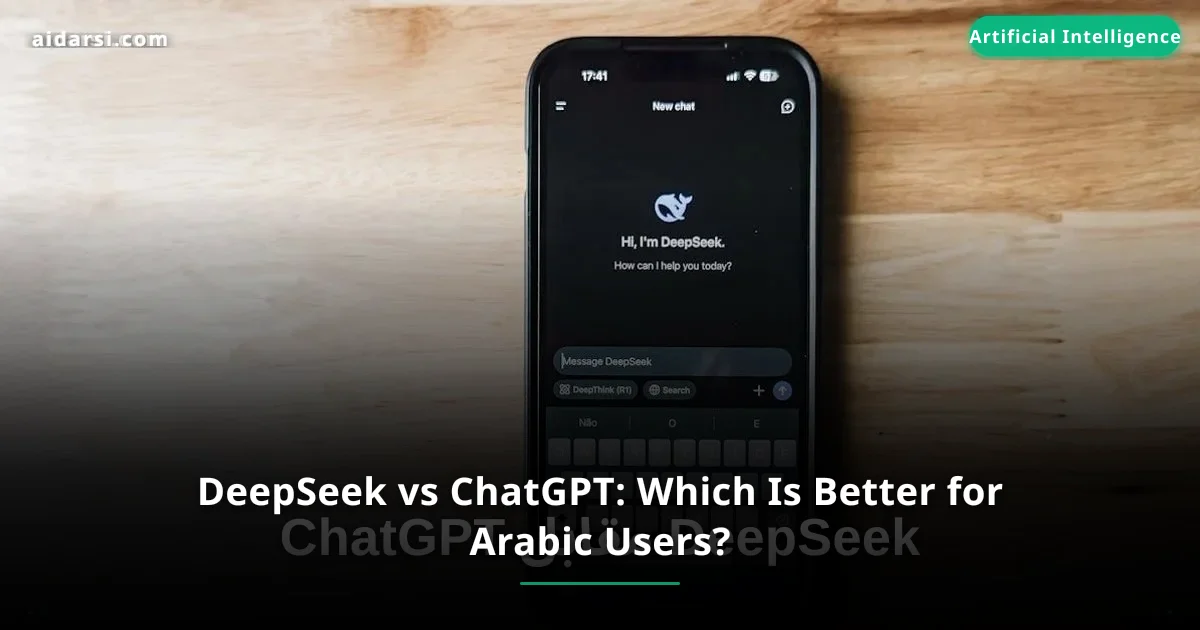
DeepSeek vs ChatGPT: Which Is Better for Arabic Users?
A practical comparison of DeepSeek and ChatGPT in 2026: Arabic performance, cost, coding, privacy, and the real strengths of each model with code examples.
What you will learn
- You will understand the real difference between DeepSeek and ChatGPT in performance and cost
- You will learn the strengths and weaknesses of each model for Arabic-speaking users
- You will discover the privacy concerns around DeepSeek and when to choose each model
Just $5.5 million. That is what it cost to train DeepSeek R1 — compared to over $100 million spent by OpenAI on GPT-4. The figure stunned Silicon Valley and sent American AI stock prices tumbling in a single day.
But does cheaper mean better? And is DeepSeek a realistic option for Arabic-speaking users, or does ChatGPT still hold the lead? These questions need straightforward answers backed by actual testing — not sensational headlines.
What Is DeepSeek and Who Is Behind It?
DeepSeek is an open-source AI model developed by a Chinese company of the same name, founded in 2023. The company is a subsidiary of High-Flyer, a Chinese hedge fund specializing in quantitative trading powered by AI.
What sets DeepSeek apart from its competitors comes down to three key points — and understanding them helps you decide when to use it and when to stick with ChatGPT:
- Fully open source — you can download the model and run it on your own machine
- Extremely low training cost — achieved competitive performance at a fraction of the budget
- Mixture of Experts (MoE) architecture — activates only the parts of the model needed for each task, saving resources
According to the Stanford HAI report in 2026, DeepSeek R1 achieved results competitive with GPT-4 on math and coding benchmarks despite a training cost 20 times lower.
As for ChatGPT, it comes from OpenAI — the company that launched the generative AI revolution in 2022. If you want to learn more about ChatGPT and its competitors, check out our comprehensive comparison of ChatGPT, Gemini, and Claude.
How Does Each Model Handle Arabic?
Arabic performance is the most important question for Arabic-speaking users — and the gap between the two models here is significant. An AI model that excels in English may produce noticeably weaker Arabic output, and this is exactly what our testing revealed.
ChatGPT in Arabic
ChatGPT has supported Arabic since launch and has improved noticeably with every release. The current versions (GPT-4o and GPT-4.5) understand Modern Standard Arabic as well as Gulf, Egyptian, and Maghreb dialects. You can write to it in colloquial Arabic and it will understand you.
Its strengths in Arabic:
- Excellent understanding of context and tone
- Producing long, coherent texts
- Accurate translation between Arabic and English
- Handling Arabic cultural content
DeepSeek in Arabic
DeepSeek was primarily trained on Chinese and English data. Its Arabic support exists but is noticeably weaker than ChatGPT's. In our testing:
- It understands Modern Standard Arabic acceptably but sometimes struggles with dialects
- Its Arabic output is shorter and less fluent
- It occasionally mixes Arabic structures with ones literally translated from English
- It performs better when you ask in English and then translate the result
# Simple test: ask both models to explain a technical concept in Arabic
# then compare the text quality

import anthropic  # or openai / deepseek API

prompt = "Explain the concept of deep learning in Modern Standard Arabic in 3 sentences"

# ChatGPT produces smooth, natural Arabic text
# DeepSeek produces correct but less fluent text

# Result: if Arabic content is your priority — ChatGPT is better
According to the LMSYS Chatbot Arena rankings (March 2026), ChatGPT holds first place in multilingual tasks while DeepSeek is in fifth place.
Which Model Is Stronger at Coding and Technical Tasks?
DeepSeek stands out here in a surprising way. On coding benchmarks like HumanEval and MBPP, DeepSeek R1 achieved results very close to GPT-4 — and sometimes outperformed it on specific tasks.
Practical Test: Solving an Algorithm Problem
# Task: find the longest substring without repeating characters
# Longest Substring Without Repeating Characters

# DeepSeek R1's solution — uses sliding window efficiently
def longest_unique_substring(s: str) -> int:
    char_index = {}
    max_length = 0
    start = 0

    for end, char in enumerate(s):
        if char in char_index and char_index[char] >= start:
            start = char_index[char] + 1
        char_index[char] = end
        max_length = max(max_length, end - start + 1)

    return max_length

# ChatGPT's solution — nearly the same approach with clearer explanation
# Both arrive at the correct O(n) solution
The real difference shows up in Chain of Thought reasoning. DeepSeek R1 displays its thinking steps in detail — which is very helpful if you are learning to code and want to understand the solution, not just copy it.
However, ChatGPT excels at:
- Explaining code to beginners in simple language
- Suggesting alternatives and multiple design patterns
- Working with entire projects, not just snippets
How Do the Costs Compare?
DeepSeek is 18-35 times cheaper than ChatGPT for API costs, and offers a free version with no clear limits versus ChatGPT's limited free tier. You can also run DeepSeek locally for free since it is open source — and this difference might be the deciding factor in your choice.
According to a16z's 2026 analysis, 60% of AI startups use open-source models (like DeepSeek and Llama) to reduce operating costs.
What Are the Privacy Differences?
Both models have different privacy concerns. DeepSeek is a Chinese company obligated to cooperate with its government and stores data on servers in China. ChatGPT retains your conversations to improve the model and shares data with Microsoft. Neither is perfect — the question is which risks matter more to you.
DeepSeek Concerns
- Compliance with Chinese law — Chinese companies are required to cooperate with the government upon request
- Content censorship — DeepSeek refuses to answer politically sensitive questions related to China
- Data storage — The privacy policy indicates data is stored on servers in China
ChatGPT Concerns
Don't assume ChatGPT is problem-free:
- Conversation storage — OpenAI retains your conversations to improve the model (unless you disable this)
- Data sharing — Close partnership with Microsoft
- Closed source — You cannot verify what happens inside the model
The Practical Solution
If privacy is your top priority, DeepSeek's open-source nature offers a unique advantage: you can run it on your own server without sending any data to any third party. This option is not available with ChatGPT.
# Running DeepSeek locally using Ollama
# No data sent to any external server

# Step 1: Install Ollama
# curl -fsSL https://ollama.com/install.sh | sh

# Step 2: Download the model
# ollama pull deepseek-r1:7b

# Step 3: Run it
import requests

response = requests.post('http://localhost:11434/api/generate', json={
    'model': 'deepseek-r1:7b',
    'prompt': 'Explain information security',
    'stream': False
})

print(response.json()['response'])
# Everything runs on your machine — complete privacy
When Should You Choose Each Model?
Rather than declaring a single winner, here are the practical scenarios:
Choose DeepSeek if:
- You are building an application and need a cheap API
- You want to run the model locally on your own server
- You primarily work in English or Chinese
- You need detailed logical reasoning for coding and math
- Your budget is limited and you don't want a monthly subscription
Choose ChatGPT if:
- You write content in Arabic — text, articles, reports
- You need deep understanding of Arabic cultural context and dialects
- You want an integrated ecosystem (web browsing, DALL-E, data analysis)
- You prefer a polished user interface and technical support
- You work on a team and everyone needs a unified tool
Quick Answers
Is DeepSeek better than ChatGPT at math?
DeepSeek R1 achieved very close results to GPT-4o on the MATH and GSM8K benchmarks. The lead alternates depending on the type of problem — but the gap never exceeds 2-3% in favor of either side. If you are a student who needs help with math, both are excellent.
Can I use DeepSeek for free?
Yes. DeepSeek offers a completely free web interface with no clear limits on usage. You can also download the model and run it on your machine if you have a GPU with at least 16GB of memory (for the 7B version).
Is DeepSeek safe to use?
The model itself is safe — especially the open-source version that has been inspected by thousands of developers. The concerns relate to the cloud platform and the privacy policy. If you are worried, run it locally on your machine and avoid the cloud platform.
Which is faster at responding?
ChatGPT is faster for standard responses. DeepSeek R1 is slower because it displays its "chain of thought" before the final answer — but that slowness comes with greater transparency in its reasoning.
Comparison summary: DeepSeek is 18-35 times cheaper and open source — ideal for coding and local deployment. ChatGPT is stronger in Arabic and more comprehensive in its ecosystem — ideal for content and diverse tasks.
؟Can I use DeepSeek and ChatGPT together?
Absolutely — and that is the smartest approach. Use DeepSeek for coding tasks, mathematical reasoning, and any work where you want detailed chain of thought explanations. Use ChatGPT for Arabic content, creative writing, image generation via DALL-E, and data analysis with Code Interpreter. The total cost is still lower than paying for ChatGPT Plus alone since DeepSeek's web interface is free.
؟Is DeepSeek really open source?
Yes. DeepSeek released the model weights under an open license, meaning you can download the model, inspect its code, modify it, and run it on your own hardware. This is fundamentally different from ChatGPT, which is completely closed source. The open-source nature means independent researchers can audit it for safety and bias — and it is the reason you can run it locally with complete data privacy.
؟How does DeepSeek compare to Claude for coding?
Claude is widely considered the strongest model for large coding projects and complex codebases. DeepSeek R1 competes closely with GPT-4o on benchmarks but falls behind Claude Opus 4 for tasks that require understanding entire codebases and maintaining consistency across multiple files. For quick coding questions and algorithm problems, DeepSeek is excellent and free. For serious software development work, Claude remains the leader.
؟What hardware do I need to run DeepSeek locally?
The hardware requirement depends on the model size. DeepSeek R1 7B (the smallest version) requires 8-16GB of GPU VRAM — achievable on a modern gaming GPU like an RTX 3080. The 32B version needs 24-32GB VRAM. The full 671B model requires multiple high-end GPUs (enterprise hardware). For most users, the 7B or 14B versions running on consumer hardware provide excellent performance for coding and reasoning tasks.
؟Does DeepSeek censor political content?
Yes. DeepSeek refuses to discuss topics politically sensitive to the Chinese government — including Tiananmen Square, Taiwan independence, and criticism of the Chinese Communist Party. It also avoids discussions that could be considered destabilizing by Chinese authorities. This censorship does not affect technical, scientific, or most business use cases, but it is important to understand before relying on it for journalism, political research, or sensitive analysis work.
؟Which model should a student use for learning AI?
For learning AI concepts, ChatGPT is more approachable — it explains things clearly and has the largest library of tutorials and examples online. For understanding how AI reasoning works step by step, DeepSeek R1 is uniquely educational because it shows its chain of thought, letting you see the model's reasoning process. Starting with AI fundamentals first will help you get more from both models.
؟What is the Mixture of Experts architecture that DeepSeek uses?
Mixture of Experts (MoE) is an architecture where the model is divided into specialized sub-networks called "experts." For any given input, only a small subset of these experts are activated — rather than running the full model. This makes the model much more efficient: DeepSeek has 671B total parameters but only activates 37B for each response. This is how it achieves near-GPT-4 performance at a fraction of the computational cost.
؟Can DeepSeek generate images like ChatGPT?
No. DeepSeek is a text-only model and cannot generate images. ChatGPT integrates DALL-E for image generation directly in the chat interface. If image generation is important to your workflow, ChatGPT (or Midjourney for higher quality) is the better choice. DeepSeek focuses entirely on text reasoning and code — and excels within those constraints.
Get Started Now
You don't need to choose just one. Smart users leverage both models — each for what it does best.
Start by trying DeepSeek's free tier for coding and technical tasks. Use ChatGPT for Arabic content and creative tasks. And if you want to explore AI Basics first, that will help you understand the differences more deeply.
The important thing is to start — because those who don't use AI tools today will find themselves falling behind tomorrow.
Sources & References

Related Tools
Related Articles
ChatGPT vs Claude: Which One Is Best for Your Needs?
A detailed comparison between ChatGPT and Claude in 2026 covering Arabic quality, coding, creative writing, pricing, and optimal use cases for each model
GPT-5 from OpenAI: What's New and How It Affects Developers
OpenAI announced GPT-5 with advanced reasoning and a larger context window — here are the key changes and their impact on programming and development.
![Illustration for ChatGPT vs Gemini vs Claude: Full Comparison 2026 [Which Is Best?]](/images/posts-en/chatgpt-vs-gemini-vs-claude.webp)
ChatGPT vs Gemini vs Claude: Full Comparison 2026 [Which Is Best?]
A hands-on comparison of ChatGPT, Gemini, and Claude in 2026. Strengths, weaknesses, pricing, and real examples to help you pick the right model.