 Cybersecurity
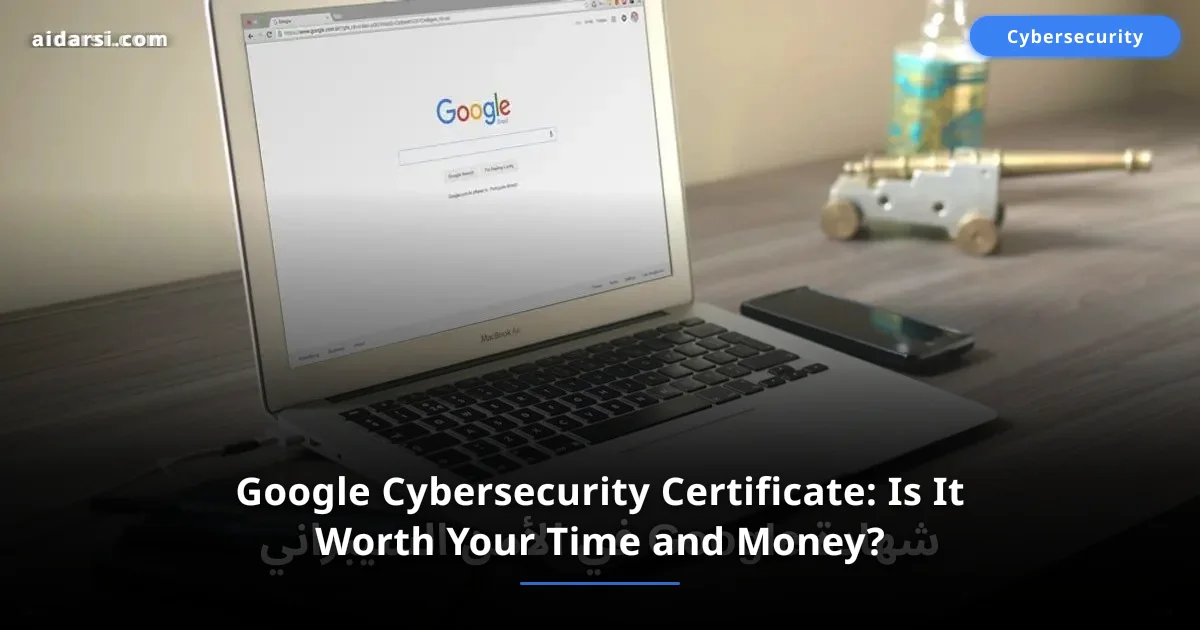
Google Cybersecurity Certificate: Is It Worth Your Time and Money?
A comprehensive review of the Google Cybersecurity Certificate in 2026 with curriculum analysis, costs, expected salaries, and comparison with CompTIA Security+ and ISC2 CC.
What you will learn
- You will know exactly what the Google certificate covers and what it doesn't
- You will compare Google's certificate with Security+ and CC to choose the best fit
- You will get a clear plan to complete the certificate in the shortest time possible
In 2023, Google's security team noticed companies complaining about a severe shortage of cybersecurity talent — but applicants lacked practical skills despite holding university degrees. Google decided to solve the problem themselves: they launched a professional certificate teaching the skills companies actually need, for under $300.
Two years later, this certificate has become one of the fastest-growing programs in cybersecurity. But is it actually worth it? That's what we'll find out in detail.
What Is the Google Cybersecurity Certificate?
The Google Cybersecurity Professional Certificate is a professional training program on Coursera lasting 6 months, designed by Google security experts to qualify complete beginners for an entry-level SOC Analyst (Level 1) position. No prior experience required.
According to Google, over 500,000 people completed the certificate by 2025 — and 75% of them landed a job or promotion within 6 months of completion.
Key Details
| Item | Details |
|---|---|
| Platform | Coursera |
| Duration | 6 months (7 hours/week) |
| Cost | ~$300 ($49/month x 6) |
| Language | English (Arabic subtitles available) |
| Prerequisites | None — complete beginners |
| Certificate | Professional certificate from Google |
| Scholarships | Available through Coursera Financial Aid |
If you're a university student, apply for the free Coursera scholarship — acceptance rates are high for Arab students. Some Saudi and Emirati universities provide free Coursera access through institutional agreements.
What Will You Learn? (8 Courses in Detail)
The program consists of 8 sequential courses that gradually build your knowledge from zero to professional level.
Courses 1-2: Foundations
- Core cybersecurity concepts (CIA Triad)
- Common threat types and attacks
- Security frameworks (NIST Cybersecurity Framework)
Courses 3-4: Network and System Security
- Network architecture and protocols
- Linux and the command line
- Asset and risk management
Courses 5-6: Practical Tools
- Splunk for security log analysis
- SQL for querying security data
- Python for task automation
Courses 7-8: Response and Employment
- Incident response
- Network traffic analysis with Wireshark
- Resume building and interview preparation
According to CompTIA's 2025 report, the skills covered by the Google certificate match 85% of entry-level SOC Analyst job requirements.
If you want to understand the fundamentals more deeply, start by reading Cybersecurity Fundamentals.
Expected Salaries After Earning the Certificate
| Region | Beginner with Google Cert | Beginner with Security+ | Difference |
|---|---|---|---|
| Global | $48,000-$58,000 | $55,000-$65,000 | +$7,000 |
| Saudi Arabia | SAR 10,000-15,000/month | SAR 12,000-18,000/month | +SAR 2,000-3,000 |
| UAE | AED 12,000-18,000/month | AED 15,000-22,000/month | +AED 3,000-4,000 |
The Google certificate alone opens doors but isn't the strongest in the government and military job market. Security+ remains the gold standard for these sectors. The optimal strategy: start with Google (easier and cheaper) then add Security+ to strengthen your position.
Comparison: Google vs Security+ vs CC
The 3 most popular beginner certifications. Which should you choose?
| Criterion | Google Certificate | CompTIA Security+ | ISC2 CC |
|---|---|---|---|
| Cost | ~$300 | $404 (exam only) | Free |
| Duration | 6 months | 2-3 months prep | 1-2 months |
| Difficulty | Easy — suitable for beginners | Medium — requires serious study | Easy — fundamentals |
| Recognition | Tech companies | Global — government and corporate | Global — (ISC)2 |
| Practical content | High (Splunk, Python, Wireshark) | More theoretical | Entirely theoretical |
| Employment in Gulf | Good — tech companies | Excellent — all sectors | Good — entry point |
For more details on each certification, read Top 5 Cybersecurity Certifications for Beginners.
The Optimal Path: How to Prepare Efficiently
Dedicate 7-10 hours per week and you'll finish the program in 4-5 months instead of 6.
Tip 1: Don't watch videos at 1x speed — use 1.5x for easy content and 1x only for complex sections.
Tip 2: Apply each lesson immediately. When you learn Splunk — open your free account and experiment. When you learn Python — write scripts yourself.
Tip 3: Join Discord and Reddit communities for the certificate. Questions and discussions reinforce understanding.
Here's a simple Bash script for checking system logs — an example of what you'll learn:
#!/bin/bash
# Quick check for failed login attempts (SOC Analyst skill)
echo "=== Failed Login Attempts ==="

# Count failed attempts in the last 24 hours
FAILED=$(grep "Failed password" /var/log/auth.log | \
    awk -v d="$(date -d '1 day ago' '+%b %e')" '$0 ~ d' | wc -l)

echo "Failed attempts (last 24 hours): $FAILED"

# Top 5 suspicious IP addresses
echo ""
echo "=== Top Attempting IPs ==="
grep "Failed password" /var/log/auth.log | \
    grep -oP '\d+\.\d+\.\d+\.\d+' | \
    sort | uniq -c | sort -rn | head -5

if [ "$FAILED" -gt 100 ]; then
    echo ""
    echo "Warning: High number of failed attempts — investigate immediately!"
fi
The Final Verdict: Is It Worth It?
Yes — with conditions. If you're a complete beginner who wants to enter cybersecurity at the lowest possible cost with genuinely practical content, the Google certificate is an excellent choice. But don't rely on it alone — consider it the first step on a longer path.
Suggested path after Google:
- Google Certificate (4-6 months) — practical foundations
- CompTIA Security+ (2-3 months) — institutional recognition
- Hands-on projects on GitHub — proof of skills
For a complete roadmap, read How to Start Your Cybersecurity Career.
Is the Google certificate recognized in Saudi Arabia and the UAE?
Yes, major Gulf tech companies (like STC, Etisalat, and Aramco Digital) accept it as a beginner certification. However, government and military positions typically require Security+ specifically. The best strategy is to get the Google certificate first, then add Security+ if you're targeting the public sector.
Can I finish the certificate in less than 6 months?
Absolutely. If you dedicate 15-20 hours per week and you're a fast learner, you can finish in 3-4 months. Some learners completed it in two months. The key is watching videos at 1.5x speed and completing exercises without delay. Every month you save means $49 less.
Do I need English language skills?
The content is in English with Arabic subtitles for text. But the practical tools (Splunk, Linux, Python) are all in English. You need at least intermediate English — the ability to read technical documentation and understand basic security terminology. If your English is weak, dedicate a month to improving it before starting.
What's the difference between Google IT Support and Google Cybersecurity?
The IT Support certificate covers general IT fundamentals: networking, operating systems, technical support. The Cybersecurity certificate specializes in security: threat detection, log analysis, incident response. If you have no technical background at all, you could start with IT Support first then move to Cybersecurity. But if you know the basics, start with Cybersecurity directly.
Final Thoughts
The Google certificate isn't a magic wand — but it's a genuine gateway at a reasonable cost with excellent practical content. If you're serious about entering cybersecurity, sign up on Coursera today and start the first course. The worst that could happen is you discover after a week that the field isn't for you — and you'll save years of wandering.
Sources & References
Cybersecurity Department — AI Darsi
Information security and digital protection specialists
Related Articles
Ransomware Attack Disables 300 Hospitals: Cybersecurity Lessons
A new ransomware attack hits a US hospital network and shuts down emergency systems — what happened and how to protect your organization from ransomware attacks
Cybersecurity Glossary: 50 Essential Terms You Should Know
A comprehensive glossary of the 50 most important cybersecurity terms with simple explanations and practical examples. Your go-to reference for digital protection
Best Cybersecurity Tools and Practices for Small Businesses in 2026
43% of cyberattacks target small businesses and 60% shut down within 6 months. A practical guide with free tools and a security plan on a budget