 Tech Career Path
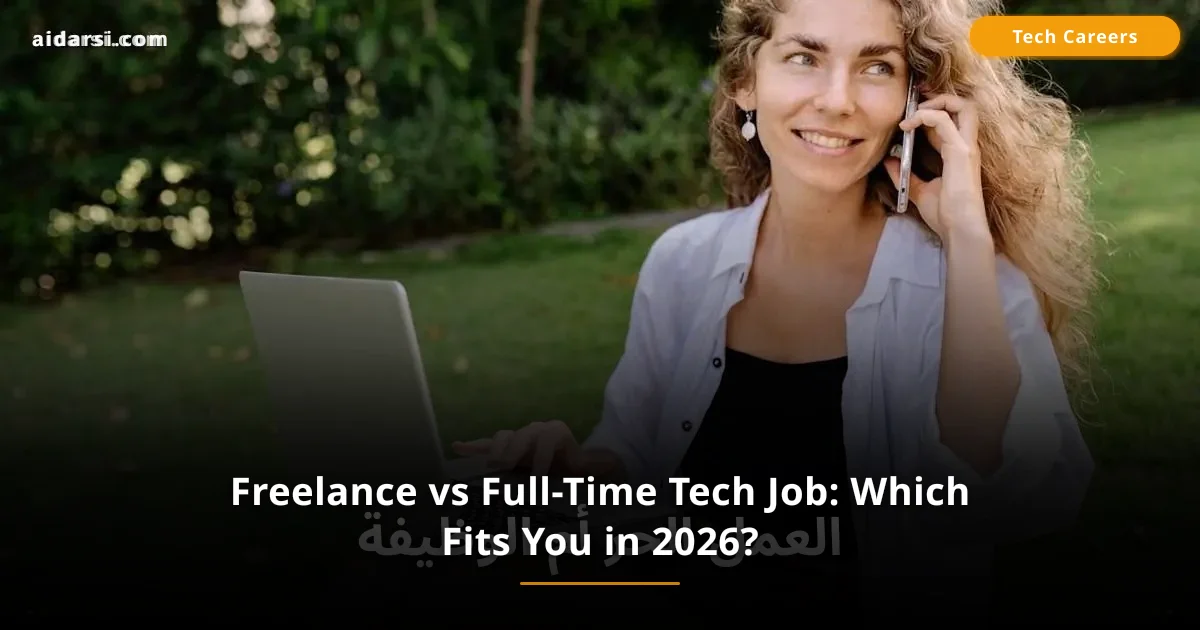
Freelance vs Full-Time Tech Job: Which Fits You in 2026?
A comprehensive comparison of freelancing and full-time tech employment in 2026 — salary, freedom, stability, career growth, and a practical quiz to help you decide.
What you will learn
- You will understand the real difference between freelancing and employment in terms of income and stability
- You will discover which path fits your personality and career goals
- You will get a practical plan for transitioning to the path you choose
Millions of developers dream of quitting their jobs and working freely from a coffee shop — but 60% of them return to full-time employment within the first year. Meanwhile, other developers earn double their salaried income through freelancing and never look back.
The difference between these two groups is not luck or skill — it is understanding which path suits their personality and circumstances. That is exactly what this guide helps you figure out.
What Is the Core Difference Between Freelancing and a Tech Job?
Freelancing means offering your tech services to different clients independently — you choose your projects, set your prices, and manage your own schedule. A full-time tech job means working for one company with a fixed salary and defined benefits.
The fundamental difference goes deeper than just employment status. Freelancing is running a business where you are the product, the salesperson, and the delivery team all at once. Employment trades some of that freedom for predictability, benefits, and structured growth.
According to Upwork's 2025 report, the number of tech freelancers worldwide has exceeded 73 million people. But that does not mean freelancing is better — it means the market is large enough to support both paths.
If you are starting your tech journey, read the comprehensive tech career guide first to understand your options. Also review which programming languages are most in demand to make sure your skills match what the market needs.
How Do the Incomes Actually Compare?
This question tops every developer's list. The short answer: it depends on your level, specialization, and location. But the numbers paint a clear picture.
Full-Time Tech Salaries (2026)
| Specialization | Junior ($/year) | Mid-Level ($/year) | Senior ($/year) |
|---|---|---|---|
| Frontend Developer | $55,000 | $85,000 | $120,000 |
| Backend Developer | $60,000 | $95,000 | $140,000 |
| Full-Stack Developer | $58,000 | $90,000 | $135,000 |
| DevOps Engineer | $65,000 | $105,000 | $155,000 |
| Data Scientist | $70,000 | $110,000 | $160,000 |
Freelance Income (2026)
| Specialization | Junior ($/hr) | Mid-Level ($/hr) | Senior ($/hr) | Estimated Annual* |
|---|---|---|---|---|
| Web Development | $25-40 | $50-80 | $100-200 | $50,000-$200,000 |
| Mobile Apps | $30-50 | $60-100 | $120-250 | $60,000-$250,000 |
| UI/UX Design | $20-35 | $40-70 | $80-150 | $40,000-$150,000 |
| Cybersecurity | $40-60 | $80-120 | $150-300 | $80,000-$300,000 |
*Annual income estimated based on 1,000–2,000 billable hours per year.
According to LinkedIn's Global Talent Trends 2025 report, mid-level freelancers earn 20–40% more than their employed counterparts — but they work longer hours and cover additional expenses.
Freelance numbers may look tempting, but remember they are before taxes, health insurance, and unpaid vacation days. Employees get these benefits included. Divide freelance income by 0.7 for a fair comparison.
What Are the Real Pros and Challenges of Freelancing?
Freelancing is not just "working from home." It is a complete lifestyle that demands skills far beyond coding.
Real Pros
1. Freedom to choose projects and clients. Nobody forces you onto a project you dislike. If a client is difficult — end the contract. This freedom is priceless.
2. No income ceiling. In a job, your salary is tied to a pay grade. In freelancing, as you build skills and reputation, your hourly rate rises without limits.
3. Time and location flexibility. Work from anywhere, anytime. Some freelancers travel the world while working — known as Digital Nomads.
Real Challenges
1. Income instability. One month you earn $8,000, the next $800. This fluctuation creates stress, especially with fixed financial commitments.
2. You are the manager, accountant, and marketer. 30–40% of your time goes to non-technical work: marketing, negotiating with clients, invoicing, follow-ups. Are you ready for that?
3. Isolation. No coworkers, no hallway chats, no team lunches. Some freelancers struggle with loneliness after months of solo work.
What Are the Real Pros and Challenges of a Full-Time Tech Job?
A job is not a "golden cage" as some freelance advocates portray it. It offers fundamental advantages that independence does not provide.
Real Pros
1. Guaranteed financial stability. A fixed salary every month, health insurance, paid vacations, and severance pay. This stability enables long-term financial planning — buying a home or starting a family.
2. Structured career growth. Large companies offer training, conferences, and mentorship programs. You learn from more experienced colleagues and build a strong professional network.
3. Working on large-scale projects. Some projects — like building a platform serving millions of users — are only available in a corporate environment. This experience is invaluable on your resume.
According to the Bureau of Labor Statistics, software engineering jobs will grow by 25% by 2032 — much faster than average. Demand for tech employees will not decline anytime soon.
Real Challenges
1. Salary ceiling. Even at the best companies, there is a maximum salary at each pay grade. Promotions take years.
2. Bureaucracy and office politics. Endless meetings, sequential approvals, and technical decisions made for political rather than technical reasons. This frustrates ambitious developers.
3. Limited flexibility. Even with remote work policies, most companies enforce fixed hours and limited vacation days.
How Do the Two Paths Compare Head to Head?
There is no "right" or "wrong" choice — only the choice that is right for you. Some of the most successful developers in the world are company employees, and others are independent freelancers. The key is understanding yourself before you decide.
Quick Quiz: Which Path Fits You?
Answer these seven questions honestly:
1. How do you handle financial uncertainty?
- (a) I can handle it and plan for it — I have 6 months of savings
- (b) It worries me a lot — I need a fixed salary to sleep well
2. Do you enjoy marketing yourself and negotiating with clients?
- (a) Yes, I like building relationships and persuading people
- (b) I prefer to focus on coding only
3. How do you work best?
- (a) Alone, at my own pace
- (b) In a team, with daily discussions
4. How important are health insurance and benefits to you?
- (a) I can cover myself — I have alternatives
- (b) Essential and non-negotiable
5. Do you have a highly in-demand specialization?
- (a) Yes — like React Native, DevOps, or cybersecurity
- (b) My skills are general — I work across multiple areas
6. What is your 5-year goal?
- (a) Building my own business or tech agency
- (b) Reaching a leadership role (Tech Lead or CTO)
7. How many hours do you want to work per week?
- (a) Flexible — sometimes 50 hours, sometimes 20
- (b) A steady 40 hours with clear work-life boundaries
Results: If you chose (a) for 5 or more questions — freelancing aligns better with your personality. If you chose (b) for 5 or more — a full-time job suits you better. An even split? Try the hybrid model below.
What Is the Hybrid Model and Is It Right for You?
You do not have to choose strictly. Many successful developers combine both paths. Work a full-time job and dedicate 10–15 hours per week to freelance side projects.
Hybrid model advantages:
- Stable income from your job + extra income from freelance projects
- Build a portfolio and client network before making a full leap
- Test freelancing without financial risk
If you choose the hybrid model, make sure your employment contract allows side work. Some companies — especially in the Gulf region — explicitly prohibit it. Read your contract carefully or consult a lawyer.
To learn more about the highest-paying tech roles, check out the top 11 highest-paying tech jobs in 2026. And if you have decided to start freelancing, we have a complete guide to freelancing as a web developer.
؟How do I transition from a full-time job to freelancing safely?
The safest transition follows three phases. First, build your freelance portfolio and land 2-3 paying clients while still employed — even small projects count. Second, once your freelance income consistently reaches 50% of your salary for three months, begin actively scaling your client base. Third, make the leap only when your freelance income exceeds your salary for two consecutive months and you have 6 months of living expenses saved. Never quit your job first and figure out clients later.
؟What are the tax implications of freelancing in Arab countries?
Tax rules vary significantly by country. Saudi Arabia does not currently impose personal income tax on individuals. The UAE also has no personal income tax. Egypt has progressive income tax rates up to 25%. Regardless of where you are, freelancers must register as self-employed in many jurisdictions, maintain records of all income and expenses, and may need to pay VAT if income exceeds local thresholds. Consult a local accountant before starting — the cost of one consultation is far less than the cost of non-compliance.
؟Which path builds better long-term career capital?
Both build career capital — but in different ways. A full-time job at a reputable company builds credentials (your employer's brand recognition), mentorship relationships, and experience with large-scale systems. Freelancing builds entrepreneurial skills, a diverse portfolio, client relationship experience, and the ability to market yourself. The most effective long-term approach is sequential: start with employment to build skills and credentials, then freelance to maximize income and independence once your reputation can sustain it.
؟Is freelancing viable as a beginner with no experience?
It is significantly harder but not impossible. The main challenge is that freelance platforms favor established profiles with reviews. Strategies that work for beginners: start on Arabic platforms where competition is lower, offer your services at reduced rates in exchange for testimonials and portfolio pieces, contribute to open-source projects to build a GitHub portfolio, and offer your skills to nonprofits or local small businesses in exchange for case studies. After 3-5 solid projects, you have enough to compete on global platforms.
؟How do I handle health insurance as a freelancer?
This is one of the most important practical considerations for freelancers. Options vary by country: in the UAE and Saudi Arabia, you can purchase individual health insurance plans from providers like Bupa, AXA, or Daman — typically $100-300 per month for basic coverage. In some countries, freelancers can join collective insurance through professional associations or freelancer unions. Budget for health insurance before calculating whether freelancing is financially superior to employment — it substantially reduces the apparent income advantage.
؟What is the typical earnings timeline for a freelancer?
Month 1-3: Building profiles, sending proposals, earning little or nothing. Month 3-6: First clients, typically at low rates ($15-25/hour), building reviews. Month 6-12: Raising rates slightly as reviews accumulate ($25-40/hour for web development). Year 1-2: Enough reviews and portfolio to be selective about clients and raise rates significantly. Year 3+: Established reputation enabling premium rates and the ability to turn away work that does not interest you. Most freelancers underestimate how long the build phase takes and give up too early.
؟Can I work remotely as a full-time employee?
Yes — remote full-time employment has expanded dramatically since 2020 and remains common in 2026. Platforms like LinkedIn, We Work Remotely, Remote.co, and FlexJobs specialize in remote tech positions. The advantages over freelancing: full benefits, stable income, structured career growth, and team collaboration — without the geographic constraint of an office. Many tech companies hire globally, meaning an Arab developer can work for a European or American company at their salary levels while living in the Gulf region.
؟Which generates more income in the long run?
In purely financial terms, highly skilled freelancers in specialized areas (DevOps, cybersecurity, AI/ML) consistently out-earn their employed counterparts. But the gap is smaller than the headline numbers suggest once you account for benefits, taxes, unpaid downtime between clients, and self-employment overhead. The more important question is which model motivates you to keep improving — a motivated employee can out-earn a burned-out freelancer. Choose the model you can sustain for a decade, not just a year.
Are You Ready?
The choice between freelancing and a full-time job is not permanent — you can change direction at any stage. Many developers start with a job to build experience, then switch to freelancing after 3–5 years. Others freelance first and then join a startup they believe in.
The only unforgivable step is not starting at all. Choose your path today — even temporarily — and begin.
Sources & References

Related Tools
Related Articles
Freelance Web Development in 2026: From Zero to Your First Client
A complete guide to starting freelance web development in 2026 — platforms, pricing strategies, building a portfolio, and landing your first client with expected earnings.
The Future of Jobs and Work in 2026: AI and Remote Work
How are AI and remote work reshaping the job market in 2026? Discover new roles, modern work models, and the skills you need to thrive in the new workforce.

How to Ace a Tech Job Interview: 11 Practical Tips
A practical guide to succeeding in tech job interviews in 2026 with 11 proven tips covering technical preparation, behavioral questions, and salary negotiation