 Artificial Intelligence
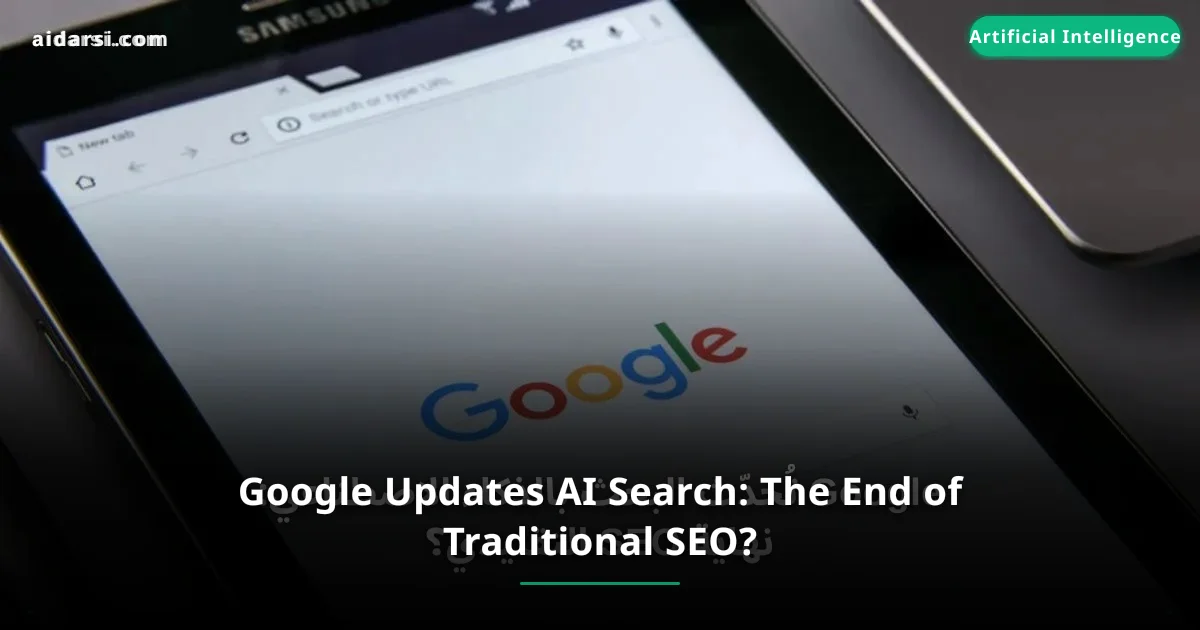
Google Updates AI Search: The End of Traditional SEO?
Google's new AI Overview update changes search rules — how it affects content creators and websites, and what adaptation strategies work.
What you will learn
- You'll understand how Google's AI Overview update changes search rules
- You'll learn how the update affects content creators and Arabic websites
- You'll discover adaptation strategies to maintain your search rankings
A 40% Drop in Clicks — The Number That Terrified Content Creators
25-40% — that's how much website clicks dropped after Google activated its new AI Overview feature. This isn't guesswork. It's the result of early studies in markets where the feature launched first.
And now it's reached the Arab region. Google announced the expansion of AI Overview to include Arabic-language search across 15 Arab countries officially.
What Actually Changed on the Search Page?
Imagine searching for "how to learn programming from scratch." Previously, you'd see 10 blue links and pick one. Now, a large bubble appears at the top containing a smart summary that answers your question directly — generated by AI from multiple sources.
The visitor reads the summary and gets their answer without clicking any website. That's exactly what concerns content creators.
| Metric | Before Update | After Update |
|---|---|---|
| Click-through rate (CTR) | 8.5% | 5.2% |
| Average time on page | 2.4 minutes | 3.8 minutes |
| Bounce rate | 65% | 45% |
But look at the other numbers — visitors who actually reach your site spend more time and engage more. Fewer clicks, but higher quality.
Does This Mean SEO Is Dead?
Short answer: no. Precise answer: traditional SEO based on keyword stuffing and shallow articles — yes, that's finished.
Think about it this way: Google can now summarize any ordinary article and display its gist directly. So why would a visitor click your article at all?
They click for one reason only — you offer something the AI summary can't provide. Personal experience. Deep analysis. Opinion built on expertise. Detailed practical examples.
Fewer visits, but visitors who arrive spend more time — quality has become more important than quantity.
What Strategies Work Now?
Instead of worrying, here's what successful content creators are doing to adapt:
Write what can't be summarized
The AI summary pulls short, shallow paragraphs. But it can't summarize a step-by-step hands-on tutorial, a comparison based on real usage, or analysis connecting multiple sources. Focus on this type of content.
Target long and complex queries
A query like "cybersecurity" — the summary handles that easily. But "how to start a cybersecurity career from scratch as a college student in Saudi Arabia" — that needs a real article with local details.
Build a personal brand
Readers no longer search for "any article" — they look for someone they trust. When they see your name in search results and know you write quality content, they'll click your link even if the summary gave them a brief answer.
Diversify your traffic sources
Total dependence on Google was risky even before this update. YouTube, TikTok, email newsletters, Twitter — each channel builds an audience that doesn't depend on a single search algorithm.
What About Ads and Revenue?
If you rely on Google AdSense for income, the impact is direct. Fewer visits mean fewer ad views. But there's a bright side — the lower bounce rate (45% instead of 65%) means visitors spend more time on your pages. This increases ad views per visitor.
The equation has shifted: instead of 1,000 visitors spending 30 seconds, you get 600 visitors spending 3 minutes. Ad revenue may not change much — but only if your content is worth staying for.
The practical solution? Don't depend on one income source. In-depth educational content opens other doors — paid courses, consulting, sponsored content. Diversifying income has become a necessity, not a choice.
The Impact on Arabic Websites Specifically
Arabic tech websites will be hit harder than others. Most rely on short news articles — exactly the type AI Overview summarizes easily.
The solution is shifting toward in-depth educational content that can't be reduced to a paragraph. An article explaining how to build a complete project, or analyzing AI tools from actual experience — this content will keep attracting clicks.
Sites investing in quality will find their visitors fewer in number but more loyal and engaged. Sites relying on volume will struggle.
You Might Be Wondering...
Will small websites disappear because of this update?
No. Small niche websites will be less affected. Google typically pulls summaries from large general sites. If your site is specialized and offers unique content — you'll still get visitors looking for depth that summaries can't provide.
Do I need to completely change my content strategy?
Not completely. You need smart adjustments: write longer, deeper articles, add personal experiences, use original data. Don't abandon SEO fundamentals — just add a layer of real value on top.
When will the update actually impact Arabic search results?
The impact has already begun since the feature was activated. But the full effect needs 3-6 months for Arab users to adopt it and get used to reading summaries instead of clicking links.
SEO has evolved greatly since its beginning, and this update isn't the end — it's the start of a new phase. Those who write real, valuable content will keep appearing and growing. The opportunity still exists, but it's shifted from "write anything and it'll show up" to "write something worth clicking on."
المصادر والمراجع
AI Department — AI Darsi
Specialists in AI and machine learning
Related Articles
How to Rank #1 on Google Using AI and SEO in 2026
Learn how to use AI for SEO in 2026. Tools, strategies, and practical techniques to rank higher in Google Search and AI Overviews.
Writing SEO Articles with AI: 8 Practical Steps
Learn how to write SEO-optimized articles using AI. 8 practical steps from keyword research to publishing and ranking on the first page of Google.
9 Best AI Apps for Students in 2026 — Free & Powerful
Discover the 9 best free AI apps for students in 2026 for studying, research, writing, and coding — with practical tips and real examples for each app.