 Tech Career Path
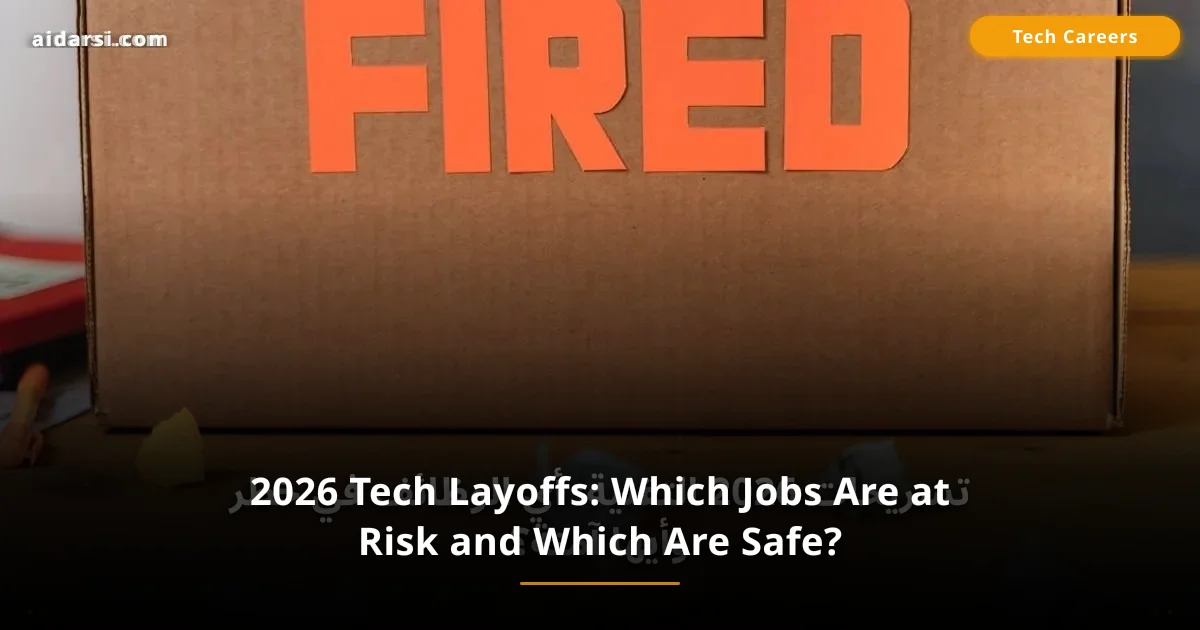
2026 Tech Layoffs: Which Jobs Are at Risk and Which Are Safe?
A new wave of layoffs hits major tech companies in 2026 — find out which roles are threatened and which skills will protect you from unemployment
What you will learn
- You'll understand the causes behind the 2026 tech layoff wave
- You'll learn which jobs are most threatened and which ones are safe
- You'll discover the skills that protect you from unemployment in the age of automation
Why Are 2026 Tech Layoffs Happening and Who Is at Risk?
The 2026 tech layoff wave has eliminated 45,000 positions in the first quarter alone — not because companies are failing, but because AI automation has made certain roles redundant while simultaneously driving massive demand for AI, security, and cloud specialists who command even higher salaries.
That's what happened to 45,000 people in the tech sector during the first 3 months of 2026. These aren't ordinary employees — engineers, managers, and designers at companies like Meta, Dell, and SAP. Some of them thought their jobs were guaranteed.
The question you should ask yourself right now: is my job on the next list? To understand the broader job market trends, read the most in-demand jobs in 2026.
Which Jobs Are Most Threatened — And Why?
AI automation is eliminating roles that involve repetitive, process-driven tasks while amplifying demand for jobs requiring judgment, creativity, and cross-domain expertise — making the choice of specialization more consequential than at any previous point in tech history.
Not all tech jobs are at risk. The sorting is clear: jobs that automated tools can perform are the most vulnerable.
Technical Project Manager — High Risk
The biggest surprise of this wave. Companies discovered that AI-powered project management tools handle 70% of a traditional project manager's tasks — scheduling, tracking, reporting. The remaining tasks can be covered by engineers themselves.
Meta alone laid off 1,200 project managers and replaced them with smaller engineering teams using automated tools.
Junior Frontend Developer — High Risk
No-code tools and AI-powered UI generation have become good enough for basic tasks. A developer who builds simple pages without deep understanding of architecture — this role is shrinking fast.
But pay attention: a senior frontend developer who understands performance, accessibility, and complex application architecture is still highly demanded. The gap between junior and senior has become the difference between unemployment and an excellent salary.
Traditional Data Analyst — Medium Risk
Descriptive data analysis (what happened and why) can be done automatically by tools. But predictive and strategic analysis — connecting data to business decisions — still needs a human mind.
Which Tech Jobs Are Safe and Growing?
On the flip side, some specializations aren't affected by the layoff wave — demand for them is actually growing:
| Job | Average Annual Salary | Demand Growth |
|---|---|---|
| Cybersecurity Engineer | $120,000 | +35% |
| AI/ML Engineer | $180,000 | +42% |
| DevOps/Cloud Engineer | $145,000 | +28% |
| Tech Lead | $165,000 | +20% |
Jobs that are hard to automate are the safest — focus on skills that AI can't replace.
Cybersecurity engineers face a global shortage estimated at 3.5 million unfilled positions. Every new ransomware attack — like the recent hospital attack — increases demand. If you're considering a career change, start here.
AI engineers — the same tools eliminating other jobs need people to build and develop them. Companies are laying off project managers to hire AI engineers at higher salaries.
What Separates Those Who Get Laid Off from Those Who Stay?
The key observation from layoff data: companies don't lay off everyone in a given specialty. They lay off those who don't add unique value. What makes you hard to replace?
Combining two specializations. A developer who understands cybersecurity. A data analyst who communicates well with management. An AI engineer who understands healthcare needs. The intersection of two skills creates value that tools can't replicate.
Building professional reputation. Those with a strong portfolio and presence on GitHub get opportunities even in the worst times. 70% of tech job opportunities come through referrals — not random applications.
Continuous learning at a steady pace. You don't need to learn everything — just one new thing each month added to your skill set. A cloud certification. A side project. An open-source contribution. Check the future of work in 2026 to understand broader trends.
Soft skills have become more important. Companies that laid off technical employees kept those who excel at communicating with clients and translating technical requirements for management. The ability to explain, persuade, and lead a team — these skills can't be automated. Learn about the most important soft skills for developers.
What Is the Situation in the Arab Region?
Layoffs aren't confined to Silicon Valley. Tech companies in Dubai, Riyadh, and Cairo have started following the same pattern — reducing support and management teams while hiring AI and security specialists instead.
But there's a real opportunity: the Arab region suffers from an acute shortage of specialized tech talent. Saudi Vision 2030 alone needs more than 100,000 new tech specialists. Recognized IT certifications open many doors in this growing market.
The difference between the Arab and Western job markets is that demand here still exceeds supply in sought-after specializations. Those who build their skills now will find excellent opportunities.
What Practical Steps Should You Take in the Next Three Months?
Instead of waiting and worrying, here's what you can do right now:
Week one: Assess your current situation. Are your skills the threatened type or the safe type? Be honest with yourself.
Month one: Pick one new skill and start learning it. If you're a developer, learn cybersecurity fundamentals. If you're an analyst, learn AI basics.
Month two: Build a project that combines your current skill with the new one. Document it on GitHub.
Month three: Expand your network. Attend tech meetups. Connect with 5 new people in your field weekly on LinkedIn.
؟Is my job safe if I have 5+ years of experience?
Experience alone is no longer sufficient protection. What matters is whether your experience is in skills that AI can replicate (routine project management, basic coding, standard data reporting) or skills that require judgment, creativity, and cross-domain expertise. Senior engineers who mentor teams, architects who make complex trade-off decisions, and professionals who translate between technical and business domains are far safer than those doing process-driven work regardless of experience level.
؟Should I change my career entirely because of these layoffs?
Not necessarily. Assess your current role's threat level honestly, then consider whether upskilling within your existing field is more practical than switching entirely. A data analyst learning AI/ML tools becomes far more valuable. A project manager who becomes expert in AI tool orchestration and prompt engineering fills a new role these companies actually need. Complete career pivots make sense when your current field is structurally declining — not just because of one wave of layoffs.
؟Which certifications help most during a layoff wave?
The certifications with the highest immediate return are cloud certifications (AWS Solutions Architect, Azure Administrator) and cybersecurity certifications (CompTIA Security+, CEH). These signal skills in areas with genuine talent shortages. AI and machine learning certifications (TensorFlow Developer, Google ML Engineer) have strong long-term value. Avoid generic management certifications — these are precisely the roles being eliminated. Read the full breakdown in IT certifications 2026.
؟Are tech layoffs just a temporary trend or a permanent shift?
This is a structural shift, not a temporary correction. The automation of routine knowledge work is accelerating, not slowing. However, tech employment overall is growing — the mix is changing, not the total. Companies that laid off 1,000 project managers hired 200 AI engineers at higher salaries. The job market for skilled tech specialists remains strong; the market for commoditized tech roles is permanently contracting.
؟How do I build a safety net if I'm currently employed?
Build your safety net before you need it: maintain an active GitHub profile with recent projects, update your LinkedIn and portfolio quarterly, cultivate relationships with 2-3 recruiters in your field, keep your skills current with at least one new certification or project per year, and maintain an emergency fund covering 6 months of expenses. The professionals who handle layoffs most smoothly are those who never stopped building their external reputation even while employed.
؟What happens to tech salaries during a layoff wave?
Salaries for in-demand skills (AI, cybersecurity, cloud) are actually increasing during this period — more companies competing for fewer qualified specialists. Salaries for threatened roles are flat or declining as supply increases from layoffs. If you're in a high-demand specialty, a layoff wave may actually be an opportunity to negotiate a higher salary at a new company that desperately needs your skills. The talent shortage in AI and cybersecurity has not abated despite overall tech layoffs.
؟Is remote work making layoffs worse?
Remote work has complicated layoffs in two ways. It has expanded competition — companies can now hire from global talent pools, meaning local workers compete internationally. But it has also expanded opportunity — you can now apply for positions at companies anywhere in the world. For skilled professionals in regions with talent shortages (like the Arab region), remote work is a net positive: access to global salaries while living locally.
؟How do I explain a tech layoff in job interviews?
Be direct and factual: "My company underwent a significant restructuring driven by AI automation, and my role was eliminated along with many others in my department." Then pivot immediately to what you did next — upskilling, projects, freelance work. Interviewers in 2026 are well aware of the current layoff environment and do not view it as a red flag. What they are assessing is your response: passive (just applying for jobs) or active (learning, building, improving).
Are You Ready?
Layoffs aren't the end of the world — they're a clear signal that the tech job market is changing. Those who read this signal and act now will find themselves in a stronger position in 6 months. Those who ignore it and rely on "job security" — might be the next name on the list.
Read more: tech career guide and highest paying tech jobs and skills needed in 2026
Sources & References

Related Articles
Most In-Demand Jobs in 2026: Future Skills for the Job Market
97 million new jobs will emerge by 2030 while millions vanish. Discover the top 10 in-demand jobs in 2026 with salaries, skills, and how to qualify.

AI Jobs in Saudi Arabia 2026: Complete Career Guide
A practical guide to AI jobs in Saudi Arabia in 2026: top roles, salary ranges, skills, portfolio ideas, and a 90-day plan for landing your first opportunity.

9 Best Freelance Platforms for Arabs in 2026: Compare and Choose the Right One
Discover the 9 best Arabic and global freelance platforms in 2026 with a detailed comparison of fees, withdrawal methods, and real income data — pick the right platform for your country and start your career today