 Cybersecurity
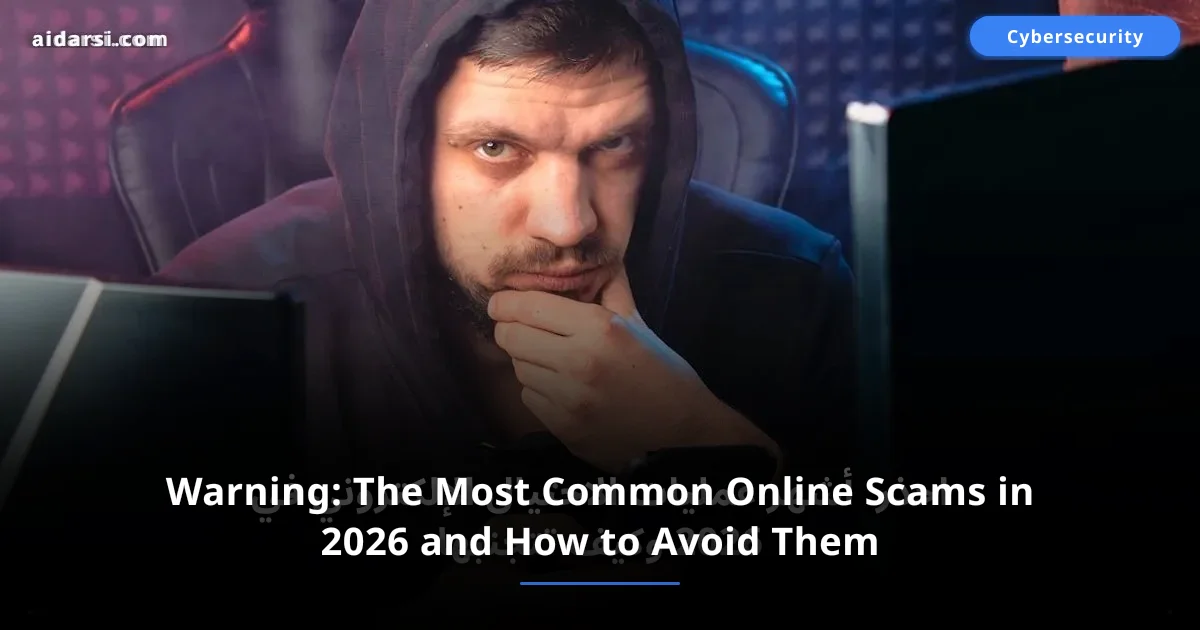
Warning: The Most Common Online Scams in 2026 and How to Avoid Them
Online fraud losses exceeded $12.5 billion globally in 2025. Learn the top 10 scams in 2026 with real-world Arab examples and instant protection tips
What you will learn
- You'll learn about the top 10 online scams in 2026 with real-world examples
- You'll understand how phishing works and how to spot it instantly
- You'll get instant protection tips to avoid financial losses
How Bad Has Online Fraud Become in 2026?
Online fraud cost victims worldwide $12.5 billion in 2025 — a 35% increase from the previous year — with the Arab region seeing a 38% surge in phishing attacks and an average victim age of 20-45 years, making digital scam awareness the most urgent personal cybersecurity skill of 2026.
In February 2025, a young Saudi man received a message from his "bank" asking him to update his details via a link. The message looked completely authentic — same logo, same style. Within 3 minutes, he lost 47,000 SAR from his account. This isn't a rare incident: $12.5 billion was lost globally to online fraud in 2025 according to the FBI, and 60% of victims are between 20 and 45 years old.
In the Arab region, phishing increased by 38% during 2025. This article exposes the top 10 scams with real-world examples and protection tips. If you haven't covered the basics yet, read cybersecurity fundamentals first.
How Do All Online Scam Types Compare?
Understanding the threat landscape before diving into specific scams gives you the mental framework to recognize a new scam even when its specific format is unfamiliar — because all scams share the same psychological mechanics regardless of delivery channel.
| Scam Type | Access Method | Financial Risk | Detection Difficulty | Most Targeted Group |
|---|---|---|---|---|
| Fake bank messages | SMS / Email | Very high | Medium | Everyone |
| Fake Apple Pay | SMS / Notification | High | Medium | iPhone users |
| Fake job offers | WhatsApp / LinkedIn | Medium-High | Low | Youth (18-30) |
| Investment scams | Ads / Telegram | Very high | High | Investors |
| Romance scams | Dating apps | Very high | Very high | Everyone |
| Fake online stores | Instagram / TikTok | Medium | Low | Shoppers |
| QR Code scams | Stickers in public places | Medium | High | Everyone |
What Are the Top 7 Online Scams in 2026?
1. Fake Bank Notifications
The most financially damaging in the Arab region. Scammers impersonate banks like Al Rajhi, Al Ahli, and Emirates NBD. You receive a message: "Your card has been blocked — update your details via this link." The link takes you to a page that's an exact copy of the bank's site.
SAMA reported that banking fraud losses exceeded 400 million SAR in the first half of 2025.
2. Fake Apple Pay and Google Pay Messages
You receive an SMS about a "suspicious payment" or that "your account will be suspended within 24 hours." The link resembles the official site (e.g., appleid-verify.com instead of apple.com).
3. Fake Job Offers
A job with an attractive salary, "flexible hours," and "no experience needed" via WhatsApp. It starts with simple tasks and small earnings to build your trust, then you're asked to "invest" a larger amount — and that's when you lose everything.
4. Fake Investment Opportunities
"Earn 500% in 30 days!" — a professional-looking investment platform. You invest a small amount and see returns to build trust. Then you're encouraged to increase the amount. When you try to withdraw, the platform disappears.
Before any investment, verify the platform is licensed by the Capital Market Authority (Saudi Arabia) or the Securities Authority (UAE). Any promise of guaranteed returns = a lie.
5. Social Media Account Hijacking
"I'm your friend Mohamed. I lost my phone and need the verification code you received." — this message costs you your account. After theft, your account is used to request money transfers from your friends.
6. QR Code Scams (Quishing)
Fake QR codes at parking lots and restaurants. In the UK, fake codes were stuck on parking meter machines, and victims were paying scammers instead of the municipality.
7. Fake Online Stores
An iPhone at half price on a sleek Instagram store. You pay and receive nothing, or you get a low-quality product. They multiply during Black Friday and Ramadan seasons.
How Do You Spot Any Scam Instantly?
# Free tools to check suspicious links and websites

# 1. Check a suspicious link before opening it (use browser):
# https://www.virustotal.com/gui/home/url
# Paste the link and get a report from 70+ security engines

# 2. Check ownership and age of a suspicious domain:
whois suspicious-site.com
# If registration date is recent (less than 6 months) = red flag

# 3. Check if your email has been exposed in breaches:
# https://haveibeenpwned.com
# Enter your email to find out if it appeared in any data breach
5 warning signs that expose any scam:
- Urgency: "Last chance," "within 24 hours" — any legitimate entity gives you enough time
- Greed: An offer that's far too good to be true
- Requesting sensitive info: Passwords, OTP codes, ID card photos
- Unofficial channels: Your bank won't contact you via WhatsApp
- Psychological pressure: "Your account will be closed," "You'll be reported to authorities"
The golden rule: any message asking you to act immediately — handle it very slowly. Open the official app directly instead of clicking any link.
What Should You Do If You Become a Victim?
- Stop communicating immediately — don't send additional money regardless of threats
- Secure your accounts — change passwords and enable 2FA. Call your bank to freeze the card
- Document everything — screenshot messages, conversations, and payment receipts
- Report it: Saudi Arabia: "Kulluna Amn" or 330330. UAE: "eCrime" or 901. Egypt: Hotline 108
- Warn others — don't feel ashamed, scammers are professionals
For deeper insight into scammers' psychological tactics, read our article on social engineering.
؟Can I recover money after transferring to a scammer?
It depends on how fast you act. Local bank transfers can sometimes be stopped if you report within hours. International transfers or cryptocurrency transfers are very difficult to recover. The rule: the sooner you report, the better your chances of recovery.
؟How do I protect elderly people from scams?
Dedicate time to explain scam types with simple examples. Enable transaction notifications. Agree on a rule: "Don't transfer any money or share any code before calling me." Install Truecaller to block suspicious calls.
؟Are scammers legally punished?
Yes. In Saudi Arabia: imprisonment up to 3 years and a fine of 2 million SAR. In the UAE: imprisonment up to 2 years and a fine of 500,000 AED. The problem is that many scammers operate from outside the country.
؟Are official banking apps safe?
Yes, official banking apps are very safe. The important thing is to download them only from the official store, keep them updated, and enable fingerprint authentication.
؟How do scammers make fake websites that look identical to real ones?
Modern scammers use automated tools that scrape every visual element from a legitimate website — logos, fonts, colors, layouts — and recreate them on a fake domain within minutes. The fake domain often uses typosquatting (adding an extra letter or hyphen), or uses a convincing subdomain like bank-name.verify-update.com. Always check the full URL in the address bar, not just what the page looks like. A padlock icon does not guarantee safety — it only means the connection is encrypted, not that the site is legitimate.
؟Is it safe to shop on Instagram or TikTok stores?
Shopping directly through social media stores carries significantly higher risk than established marketplaces. Before buying from any social media store, verify the seller's registration on an established platform (Amazon, Noon), search for reviews outside the platform, check how long the account has been active, and look for a working customer service contact. Avoid any seller that only accepts bank transfer, cryptocurrency, or payment apps — legitimate businesses accept credit cards that allow chargebacks. For anything over $50, stick to established platforms with buyer protection.
؟What is romance scam and how does it work?
Romance scams involve a scammer creating a fake persona on a dating app or social media, building a genuine emotional relationship over weeks or months, then requesting money for an "emergency" — medical, travel, business, or family crisis. The victim has already invested significant emotional connection and often sends money repeatedly. These scams are among the hardest to detect and the most financially devastating, averaging $10,000+ per victim. Signs: the person never video calls (or uses stock footage), always has a reason they can't meet, and the relationship escalates unusually fast.
؟How do I safely verify if a message from my bank is real?
Never click links in bank messages. Instead: open your bank's official app directly, or call the number on the back of your debit card. Your bank will never ask for your full password, PIN, or OTP via SMS, email, or phone call. If you receive a message claiming your account is at risk, treat the link as suspicious by default and verify through official channels only. A simple rule: real emergencies at your bank can always be handled by calling the number on your card.
Are You Ready?
Technology alone isn't enough. Your real weapon is awareness and critical thinking. Remember three rules:
- Slow down: Don't make decisions under pressure of urgency
- Verify: Confirm the sender's identity through a different channel
- Ask: If in doubt, ask someone you trust before acting
Online fraud evolves every day, but the methods stay similar: urgency, fear, temptation. If you learn to recognize these patterns, you'll spot any scam attempt before falling for it — no matter what new form it takes.
Share this article with your family — every person who reads it is one fewer victim. Follow our articles on cybersecurity and check out social engineering tactics.
Sources & References

Related Articles
Phishing Protection 2026: 7 Signs to Spot Attacks Instantly
Phishing protection in 2026: learn the 7 signs to spot fake emails instantly, the 8 latest attack types (AI, quishing, BEC), and how to protect your accounts.
Social Engineering: How Hackers Trick You Without Hacking Your Computer
Learn about the most dangerous social engineering techniques from phishing to pretexting, how hackers exploit human trust, with real incidents and effective protection methods.
Ransomware Attack Disables 300 Hospitals: Cybersecurity Lessons
A new ransomware attack hits a US hospital network and shuts down emergency systems — what happened and how to protect your organization from ransomware attacks