 Artificial Intelligence
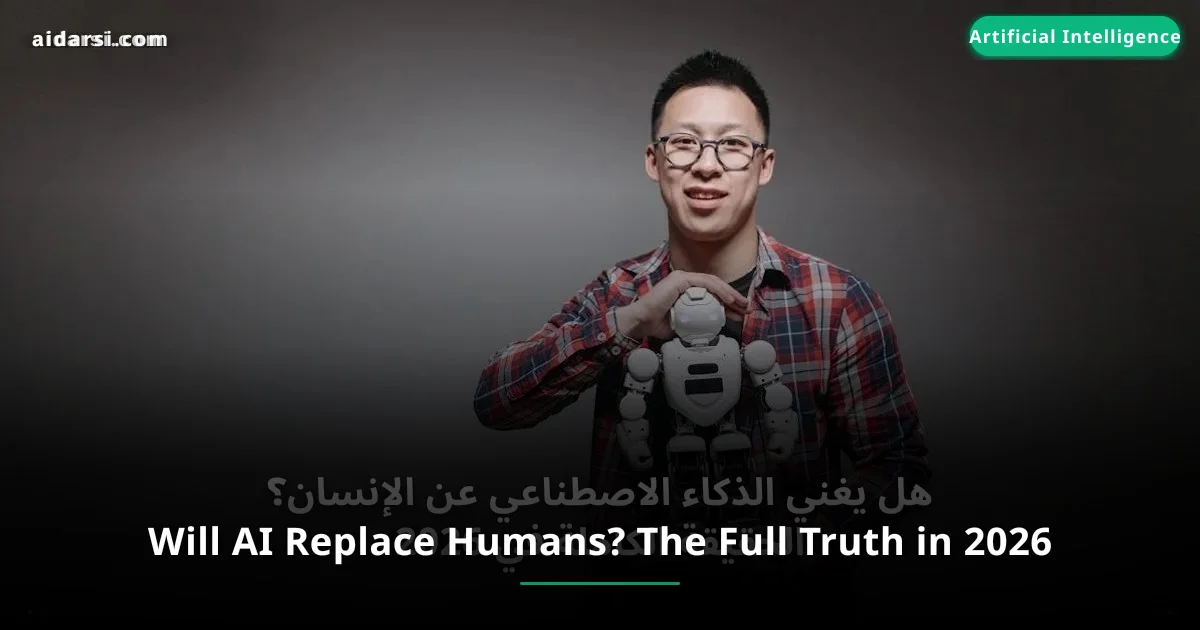
Will AI Replace Humans? The Full Truth in 2026
Will artificial intelligence replace humans at work? A comprehensive analysis of threatened and safe jobs, new AI-created roles, and practical tips for adapting to the AI era
What you will learn
- You will understand which jobs are truly threatened by AI and which are safe
- You will learn about new jobs created by artificial intelligence
- You will discover practical tips for adapting to the AI era and staying relevant
Introduction
"Will AI take my job?" — this question worries 77% of workers worldwide according to PwC's 2026 survey. The concern is legitimate: AI writes articles, designs logos, codes applications, and diagnoses diseases.
But the truth is more nuanced than a simple "yes" or "no." Let's analyze objectively: which jobs are truly at risk? Which are safe? And what new jobs has AI created?
The short answer: AI won't replace humans — but it will replace those who don't use AI.
Article Contents
- Jobs threatened by AI
- Jobs safe from replacement
- New jobs created by AI
- How to adapt to the AI era
- Expert opinions
- AI limitations and constraints
Jobs Threatened by AI
High-Risk Jobs (70%+ likelihood of impact)
These jobs rely on routine, repetitive tasks where AI excels:
1. Data Entry and Basic Accounting
AI processes invoices and data with 99.9% accuracy at speeds multiple times faster than humans. Tools like UiPath and Automation Anywhere fully automate these tasks.
2. Basic Text Translation
DeepL and Google Translate have reached a level that makes simple literal translation nearly free. However, creative and specialized translation still requires human expertise.
3. Routine Customer Service
Smart chatbots handle 80% of customer inquiries. Saudi banks like Al Rajhi and Al Ahli use AI bots that speak Arabic fluently.
4. Basic Design and Templates
Tools like Canva AI and Adobe Firefly produce designs with quality sufficient for most everyday needs. Designers who rely solely on pre-made templates will be affected.
5. Routine Report Writing
Financial reports, meeting summaries, newsletters — AI writes them in seconds. Associated Press has been using AI to write earnings reports for years.
Medium-Risk Jobs (30-60% likelihood of impact)
| Job | Reason for Impact | What Stays Human |
|---|---|---|
| Accountant | AI automates calculations | Strategic analysis and consulting |
| Marketing Manager | AI writes content and ads | Strategy and relationships |
| Junior Developer | AI writes basic code | Architectural design and problem solving |
| Journalist | AI writes breaking news | Investigations and deep analysis |
Jobs AI Won't Replace
1. Deep Creative Work
AI mimics creativity but doesn't innovate from nothing. Film directors, novelists, innovative fashion designers — they add a unique human vision that AI doesn't possess.
AI produces 1,000 images per minute, but which image tells a story is decided by a human.
2. Strategic Leadership and Management
AI provides data and analytics, but making critical decisions requires human wisdom. CEOs balance factors AI doesn't understand: company culture, team morale, long-term vision.
3. Education and Mentorship
A real teacher doesn't just transfer information — they inspire, motivate, and understand each student's needs. AI is an excellent assistant for teachers, but not a substitute for the human connection in education.
4. Complex Healthcare
AI diagnoses with high accuracy, but the doctor handles the frightened patient, explains options, and makes complex decisions in the operating room. Surgeons, psychiatrists, and nurses — their jobs are secure.
5. Skilled Trades and Fieldwork
Plumbers, electricians, auto mechanics — these jobs require physical interaction with changing environments that current robots struggle with.
6. Social and Humanitarian Work
Social workers, psychotherapists, marriage counselors — these professions depend on empathy and deep understanding of human emotions. AI fundamentally lacks this dimension.
New Jobs Created by AI
Jobs That Didn't Exist Before 2024
1. Prompt Engineer
Writes precise instructions for AI models to get the best results. Salary: 15,000-50,000 SAR/month. Learn more in our Prompt Engineering Guide.
2. AI Trainer
Trains AI models to understand local language and culture. Demand for Arabic AI trainers is growing significantly.
3. AI Ethics Officer
Ensures AI systems operate fairly and without bias. A new role at major corporations and governments.
4. AI UX Designer
Designs how humans interact with AI systems — from chat interfaces to voice commands.
5. AI Data Analyst
Analyzes AI system outputs and verifies their accuracy. Combines technical expertise with domain knowledge.
Practical example — comparing human vs AI speed in a data analysis task:
# Comparing human vs AI performance in data analysis
import time

# Simulating analysis of 1000 financial reports
reports_count = 1000

# Estimated time for a human (3 minutes per report)
human_time_minutes = reports_count * 3
human_time_hours = human_time_minutes / 60

# Estimated time for AI (2 seconds per report)
ai_time_seconds = reports_count * 2
ai_time_minutes = ai_time_seconds / 60

# Print results
print(f"Analyzing {reports_count} financial reports:")
print(f"Human: {human_time_hours:.0f} work hours")
print(f"AI: {ai_time_minutes:.0f} minutes")
print(f"Difference: AI is {human_time_minutes / ai_time_minutes:.0f}x faster")
print(f"But: human review of results is still essential!")
AI doesn't eliminate the human — it transforms their role from executor to reviewer and decision-maker. Those who master this transition win.
The Numbers
- LinkedIn recorded a 400% increase in AI jobs during 2025-2026
- Average salary for AI roles in the Gulf: 25,000-60,000 SAR/month
- Demand exceeds supply by 3x — a golden opportunity
How to Adapt to the AI Era
1. Learn to Use AI in Your Current Job
You don't need to change careers — you need to add AI as a tool to your work. Accountant + AI = 10x better accountant.
2. Develop Skills That AI Lacks
- Critical and analytical thinking
- Human communication and empathy
- Creativity and complex problem solving
- Leadership and team management
3. Specialize Deeply
AI knows a little about everything. You need to know a lot about something specific. Deep specialist + AI = an unstoppable force.
4. Build a Strong Network
Human relationships can't be replaced by AI. Your professional network is your most valuable career asset.
5. Stay Flexible and Embrace Change
Those who adapt quickly win. Don't cling to one way of working — keep learning and experimenting.
6. Invest in Continuous Education
Dedicate 5 hours weekly to learning new skills. Read about Top In-Demand Skills in 2026.
7. Think Like an Entrepreneur
Even as an employee, ask yourself: "How do I add unique value that AI can't provide?" This mindset protects your job and opens new doors.
Don't fear AI — fear not learning. The person who uses AI today will lead a team tomorrow.
Expert Opinions
The Optimists
Sam Altman (OpenAI): "AI will create enough wealth to improve everyone's lives. Jobs will change but won't disappear."
International Monetary Fund: "AI will boost global productivity by 7% by 2030 — equivalent to trillions of dollars in new value."
The Cautious
Elon Musk: "AI is the biggest existential risk facing humanity. It must be strictly regulated."
Goldman Sachs Report: "300 million jobs will be affected by AI by 2030 — but the same number of new jobs will be created."
The Realists
World Economic Forum Report 2026: "AI will eliminate 85 million jobs and create 97 million new ones — a net positive, but the transition needs management."
AI Limitations and Constraints
What AI Cannot Do
1. True Understanding
AI processes patterns in data — but it doesn't understand the meaning of what it says. It can write a sad poem without feeling sadness.
2. Original Creativity
AI recombines what it has learned. True creativity — creating something that never existed before — remains exclusively human.
3. Empathy and Emotional Intelligence
AI can simulate empathy, but it doesn't feel it. In professions requiring genuine emotional connection, humans are irreplaceable.
4. Ethical Judgment
AI has no conscience. Complex ethical decisions — when is a lie merciful? When is the law unjust? — require human wisdom.
5. Adapting to Surprises
AI excels in predictable situations but stumbles when facing unprecedented events. Humans improvise and innovate solutions to problems they've never seen before.
Conclusion
AI will not replace humans — but it will replace those who refuse to adapt. The balanced truth:
- Some jobs will disappear — this is natural (it happened with every industrial revolution)
- New jobs will be born — more in number and higher in value
- The key: learn + adapt + use AI as a tool
Don't wait until your job is affected. Start today by learning about AI basics, and explore the Tech Career Guide to build your future.
المصادر والمراجع
AI Department — AI Darsi
Specialists in AI and machine learning
Related Articles
5 Most Powerful AI Technologies Reshaping the World in 2026
Explore the 5 most powerful AI technologies transforming the world in 2026 — from smart robots to personalized medicine and self-driving cars.
Top 20 AI Tools in 2026: A Complete, Up-to-Date Guide
A comprehensive, updated list of the 20 best AI tools in 2026 for writing, coding, design, video, audio, and productivity with pricing and use cases.
The Future of Jobs and Work in 2026: AI and Remote Work
How are AI and remote work reshaping the job market in 2026? Discover new roles, modern work models, and the skills you need to thrive in the new workforce.